Xia and Shang: China's First Dynasties
Every Chinese dynasty that followed claimed descent, in spirit if not in blood, from the first two: the Xia and the Shang. The Xia is the dynasty of legend — remembered in stories of a hero who tamed the floods, but with no writing of its own to prove it existed. The Shang is the first dynasty we can touch: its kings wrote questions to their ancestors on turtle shells and ox bones, cast bronze vessels of astonishing skill, and ruled from cities on the Yellow River more than 3,000 years ago. Together they mark the moment China stepped out of prehistory and into history.
In short
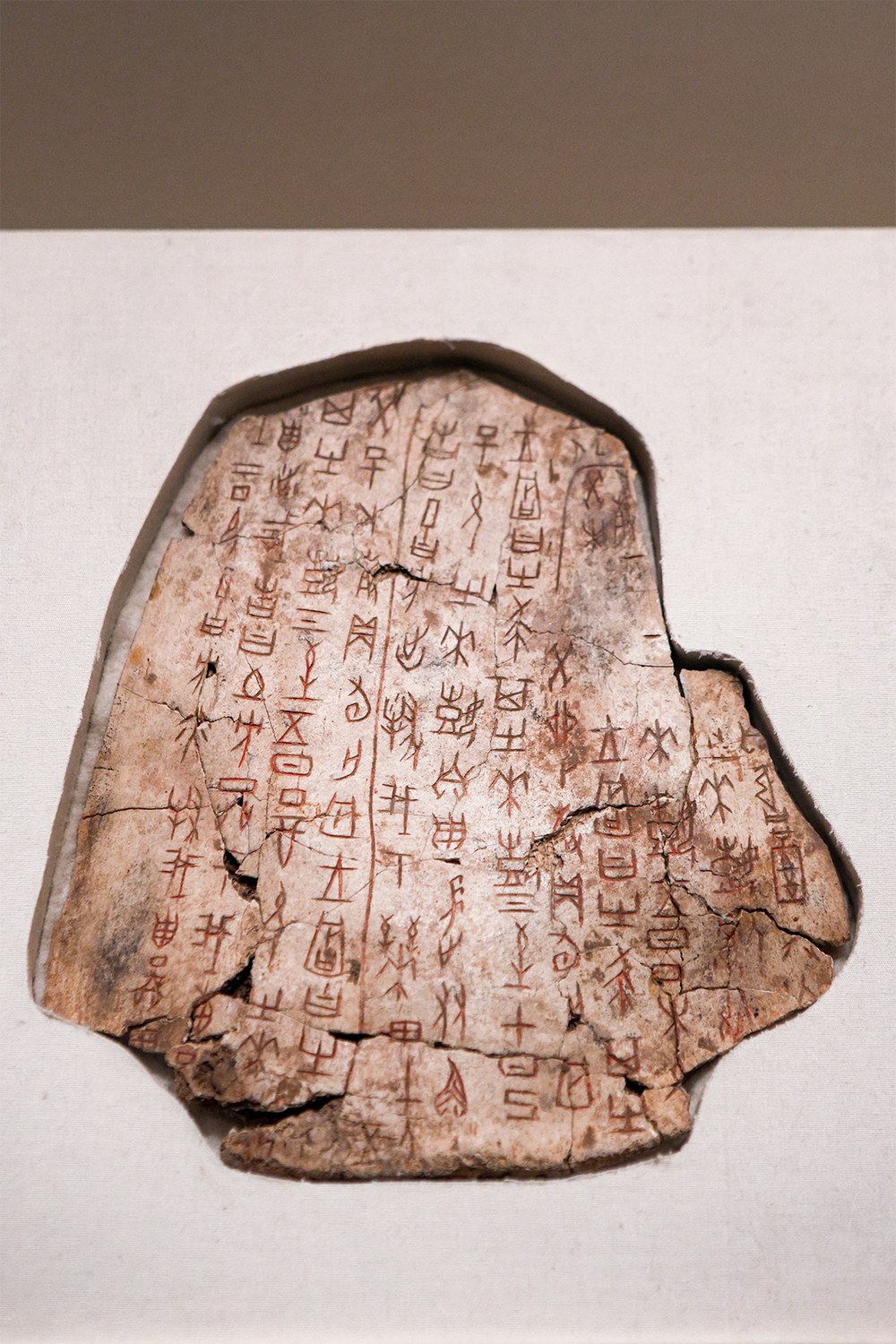
The Xia (traditionally c. 2070–1600 BCE) is China's first dynasty according to later histories, but it has left no writing, so historians still debate whether it was a real kingdom or a remembered legend — most link it to the Erlitou culture on the Yellow River. The Shang (c. 1600–1046 BCE) is the first dynasty confirmed by its own records: more than 200,000 oracle bone fragments, the oldest Chinese writing, found at Anyang, its last capital.
The Xia: a dynasty of tradition
Chinese histories written centuries later, above all Sima Qian's Records of the Grand Historian (c. 94 BCE), begin with the Xia. The story says the hero Yu the Great stopped the flooding of the Yellow River by digging drainage channels, and that when Yu died his son Qi inherited the throne — the first time kingship passed from father to son. Sima Qian lists 17 Xia kings over 14 generations, ruling for about 470 years.
Modern scholars give the Xia the traditional dates of about 2070 to 1600 BCE, following the Xia–Shang–Zhou Chronology Project of 2000. But no inscription has ever been found that names a Xia king. The strongest candidate for the Xia is the Erlitou culture, a Bronze Age settlement east of Luoyang discovered in 1959, with palaces, bronze workshops, and a turquoise-inlaid plaque that hints at a royal court. Most scholars agree Erlitou was probably the Xia capital — but without writing, the link cannot be proved, and the Xia remains a dynasty of tradition rather than of evidence.
The Shang: the first dynasty we can read
The Shang is different. According to Sima Qian, the last Xia king, the tyrant Jie, was defeated by Cheng Tang, founder of the Shang. The dynasty ruled the middle Yellow River plain for about five and a half centuries, moving its capital several times before King Pan Geng settled at Yin — modern Anyang in Henan province — around 1300 BCE. Anyang was the last Shang capital, from about 1200 to 1046 BCE.
What makes the Shang certain is writing. In 1899 a Chinese scholar noticed ancient characters carved on bones being sold in an apothecary as medicine. The bones were traced to fields near Anyang, where excavations began in 1928. More than 200,000 fragments have been found — mostly turtle shells and ox shoulder blades — covered in questions the kings asked their ancestors: Will it rain? Should we attack? Will the harvest be good? Diviners heated the bone until it cracked, and read the crack as the answer. These oracle bones, dating from about 1250 BCE, are the oldest Chinese writing, and their characters are already the ancestors of the ones used today.
Bronze, war, and a queen general
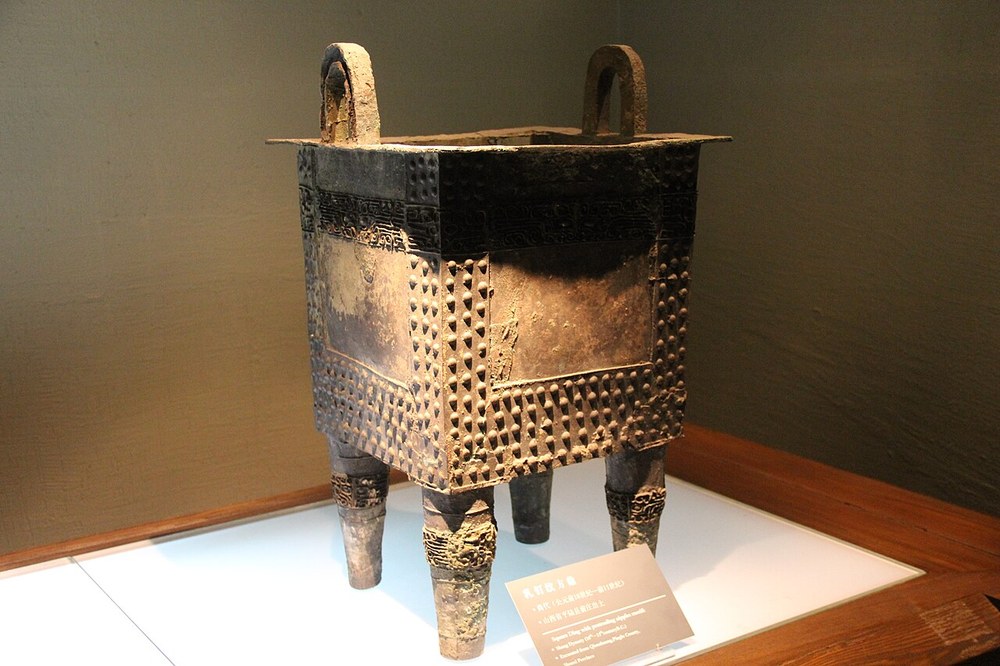
Shang craftsmen cast ritual bronze vessels of extraordinary size and beauty, some weighing hundreds of kilograms, decorated with animal faces and patterns. Bronze was not for tools — it was for ritual, for feeding the ancestors in ceremonies that held the kingdom together. The state could also raise armies of thousands, and its kings hunted, warred, and sacrificed on a grand scale.
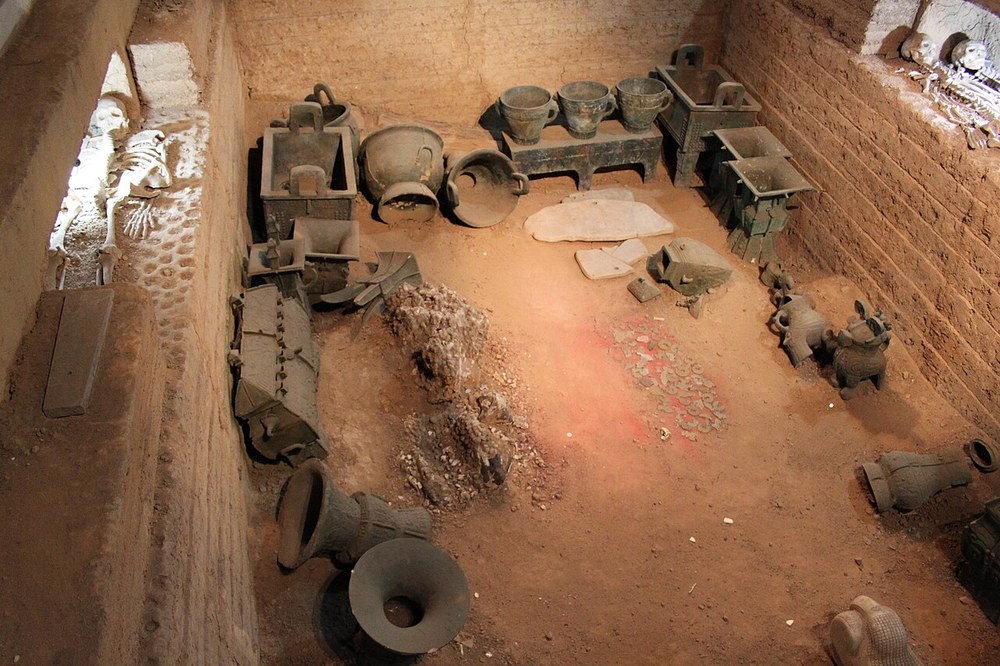
One of the most remarkable finds at Anyang is the tomb of Fu Hao, a queen of King Wu Ding, discovered intact in 1976. Fu Hao led armies into battle and was buried with 468 bronzes, jade, and ivory — proof that women could hold real military power in the Shang court. Her tomb is the only royal Shang tomb ever found unlooted.
The Shang ended at the Battle of Muye in 1046 BCE, when the Zhou — a western people the Shang had long treated as subjects — defeated the last Shang king. The victors would explain their conquest with a new idea, the Mandate of Heaven, that would shape Chinese politics for the next 3,000 years.
Sources: Humanities LibreTexts, "China from Neolithic Village Settlements to the Shang Kingdom"; TheCollector, "An Overview of the Xia, Shang, & Zhou Chinese Dynasties"; IASNOVA, "Chinese Dynasties in Order: Timeline and Map"; Britannica, "Shang dynasty" Checked 27 November 2026.